



Public and Critical Infrastructure
Public and critical infrastructure—including hospitals, emergency response centers, water treatment facilities, communication sites, transportation hubs and government buildings—requires a highly reliable and resilient power supply.
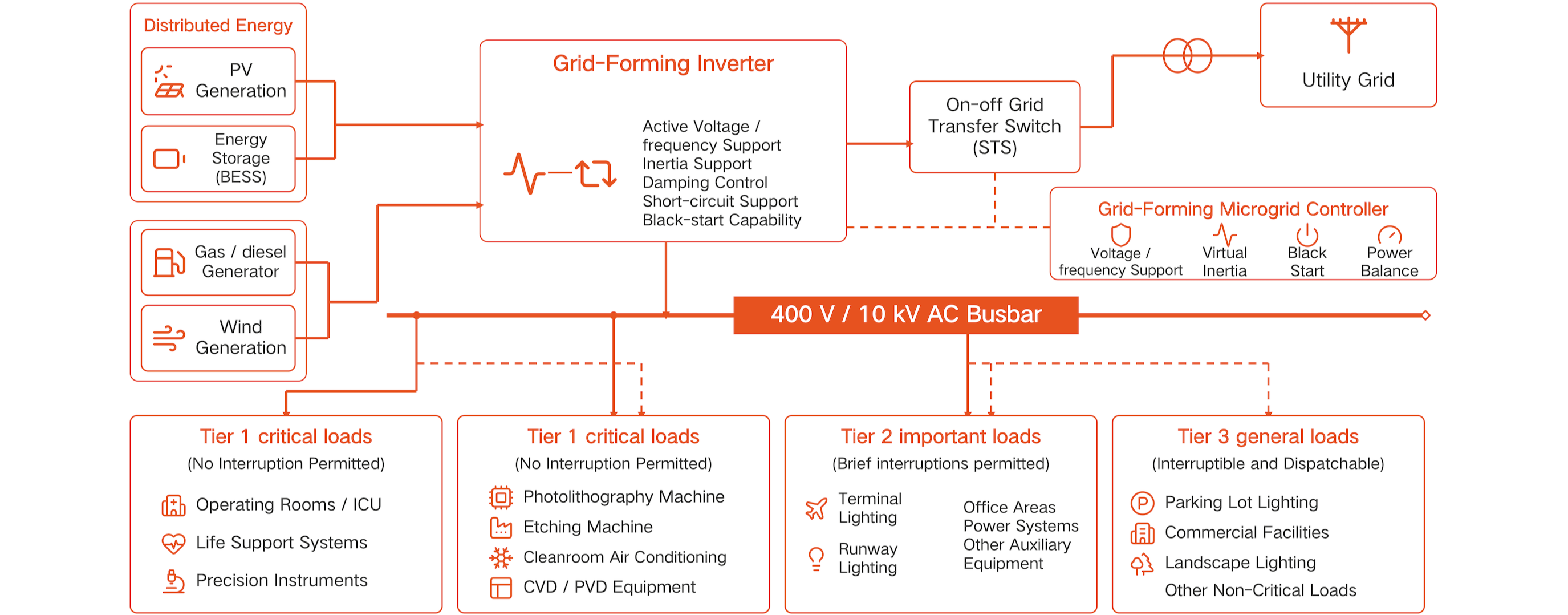
By integrating energy storage, distributed generation, backup power and intelligent energy management, the microgrid coordinates multiple energy resources and prioritizes critical loads. When properly configured, it can support both grid-connected and islanded operation, helping maintain essential services during grid disturbances or outages while improving energy efficiency and renewable energy utilization.
Advantages of the Plan

-
Reliable Power for Critical Loads
Prioritizes essential loads and reduces the risk of service interruption during grid disturbances and power outages.
-
Flexible Grid and Island Operation
Supports grid-connected and islanded operation based on project configuration, improving power resilience under different operating conditions.
-
Intelligent Energy Coordination
Coordinates the grid, energy storage, renewable generation, backup generators and controllable loads through unified energy management.
-
Lower Cost and Higher Efficiency
Uses peak shaving, load shifting and demand management to control electricity costs, ease capacity constraints and improve on-site renewable energy utilization.
Electrical Diagram